
The bargain juicer literally exploded while I juiced grapes! A centrifugal juicer, the juicer’s strainer basket/shredder disk dislocated itself, blasted through the plastic top cover like a terrorist’s bomb. Then the shredder disk rocketed into the air, spun like a UFO, landing 20 feet into the living room. Grape remnants stuck to the kitchen ceiling, the dining room chandelier and cabinets—about 10-feet west—and some plastered the TV screen in a protective cabinet.
Category: Life
A Periwinkle Sweater Waits for Winter
“This is like living in a third-world country with high-end tax bills!” I screamed while scrubbing the bathroom with the captured water, which was not going to leave enough water to flush the toilet later on. I took a break. When I looked at my garden, the artichoke plants drooped like my sullen mood. They needed water. Thank goodness we captured some rainwater from the roof into a 300-gallon tank that sits in the driveway. It’s the new drought fashion accessory.
Milkweed for Migrating Monarchs
This story can also be read in The Cambrian Embedded just over my right eye is a one-inch scar. I was a tad over three-years-old and a tad… Read more “Milkweed for Migrating Monarchs”
Picture This! Exploring Creativity in Digital Technology

When my 65th birthday struck, I didn’t fly to Hawaii or float on a Caribbean cruise. I gifted myself with a semi-professional camera, with interchangeable lenses that included zoom, and wide-angle possibilities. It was time to leave my point-and-shoot digital camera behind. No longer could it capture what I see in my minds-eye when my true eye peers through a viewfinder. Plus, when I showed some photos to a working photographer for a book idea, his critique noted, “Charmaine, get a real camera!”
I knew he was right on because a part of my professional life included photo assignments ordered by my newspaper section editor when the trained photographers were unavailable. Again, I had to buy a “real camera” (35mm) and learn how to use it. Trained photographers and editors taught me what I know today.
Those were the days of canvas camera bags lumped with rolls of ISO 400 black and white film, proof sheets and a loupe. For cover photos we shot with slide film, developed the slides and slipped them into sheets of pocketed plastic to view. The real magic happened beneath a red light in the darkroom.

Many terms remain, but a litany of technical and non-technical slang (selfies—which back in the 80s was something one might perform alone in a room) bombarded me with my new camera’s manual. It may as well been written in ancient Greek.
I’m on another learning curve with this thing called a DSLR camera that produces amazing photographs–when I get lucky. And just about the time I think I have this digital photography under my belt, a return email from a magazine editor noted, “Love the photos, but can you send them in high-resolution?”
What does he mean high-resolution? They aren’t in high-resolution? They have to be? What did I do wrong?
In turn, I sent out panic emails to working photographers with a blood curdling subject line—like I’m going to have a heart attack or something.
Within 3 hours I learned about RAW vs JPEG, need for Dropbox, Lightroom, blah, (still panicked), blah.
I know JPEG, and had recently discovered RAW settings on my camera. But, frankly, the word RAW scared me to death.

This is when I feel very old and out of touch and wish that some technology remain un-invented. It’s like the smart television that makes me feel like a dumb human.
Fortunately, the day after my near and RAW meltdown, I met with seven other women for a 3-day photo journey in the desert. This gathering of Old Broads With Cameras (OBWC) included photography undergrads, artists, and hobbyists. Our ages ran from 50-something to 70-something. Some in fabulous shape, others working on fabulous shape. After settling into the Desert Hot Springs house we rented, there was one thing we agreed upon, digital technology changed most everything we knew back in those good ol’ days of ISO 400 B&W film for 35mm cameras. But we loved the potential.
Yes, we remained on a learning curve.
Yes, we would hike, but not on difficult and long trails.
Yes, we wanted to test our photo chops with predawn photos in the desert.
Yes, we would have a good time.
“Are you going to shoot manual or automatic?”
“RAW will give you the best post-shooting options.”
“What lens do you plan to use at predawn?”
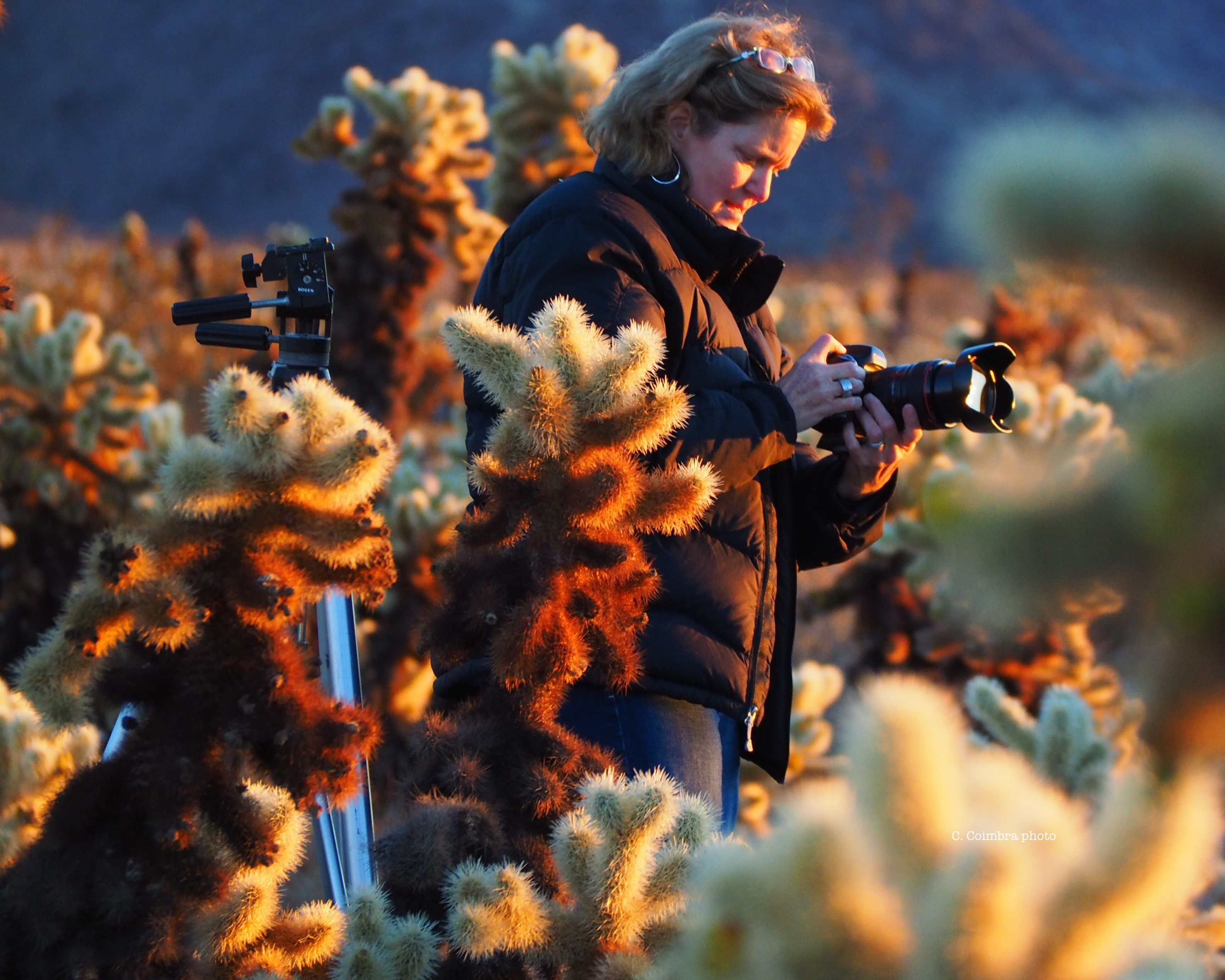
Tripods, water bottles, and back packs weighed down my car. OMG, I was in creative women heaven as we laced our hiking boots, hung cameras around our necks and hitched backpacks to our bodies and began our first trek along a moderate trail in Joshua Tree National Park. A few of our crew brought their sketch pads and paints for some plein air fun.
Each woman wandered at her own pace and let her creative eye go buck wild. Limitations be damned! Just shoot it!
After our mountain top sunset photo shoot, exhausted and hungry, we returned to our 4-bedroom rental, slipped our photo cards in to our Macs and ewwed and awwed at each other’s compositions. Together, probably a 1000 or more frames.
The next day included a predawn and sunrise photo shoot. This was far from my personal photo taking experience. I studied the how-to and prayed I’d retain the info. I didn’t come home with a money-maker predawn photo, but I’m pleased with my first attempt. It was the support that made all the difference. No one played know-it-all. Everyone agreed we each had something to learn and share in this digital world of photography, and we’re not afraid!
Personally, I applaud myself for giving me the best birthday present ever—that semi-professional DSLR—even if I’m still digesting terms like, 16.3MP Live MOS Sensor, and Micro Four Thirds System. It’s a fresh view on creativity for this OBWC.
Lust! Gluttony! Greed! & Sloth! Oh Resolution!
“I promise to forego lust, gluttony, greed and sloth this year…”
That quote is definitely not mine. But they are the final four of the seven deadly sins that build annual New Year’s resolutions lists. They are the corporal sins, or sins of the body.
California’s Rich Field Moment
…the moistened soil–autumn-sun warmed–seduced dormant seeds awake. A resurrection of green slipped through the layer of fallen leaves and dried grasses. By morning a thunderous roar filled the canyon. The Kaweah River no longer struggled to trickle through plump gray boulders.
Joni Mitchell, “In Her Own Words”
I knew I made the right choice for my next book to read when I opened to the introduction and it read, “One November night in 1966…the coffeehouse was a dark hole…on the lit-up stage…stood a girl who must have picked out her miniskirt at the Salvation Army…she turned to face the empty seats and, leaning closer to the mike she strummed a succession of chords with a surprisingly assertive hand…and then she started to sing…”
Life & Toes in Drought
See this map? See the blood-red area of California along the coast? That’s where I live. It’s Exceptional-droughtland. And less than a year ago, our local community water providers left Pollyanna-land, and informed us citizens that there was a huge likelihood of our wells going dry by late 2014.
How Apples & Pennies Defeated Terrorism
But something went terribly wrong. On Tuesday morning, September 11, 2001, horror stuck America. I asked, “Should I cancel the fundraiser?” The resounding reply was, “No! If ever we needed to do something good, and enjoy our country’s harvest, we need a day in your orchard. Keep the event!”
A Moment in Time with A WWII Hero
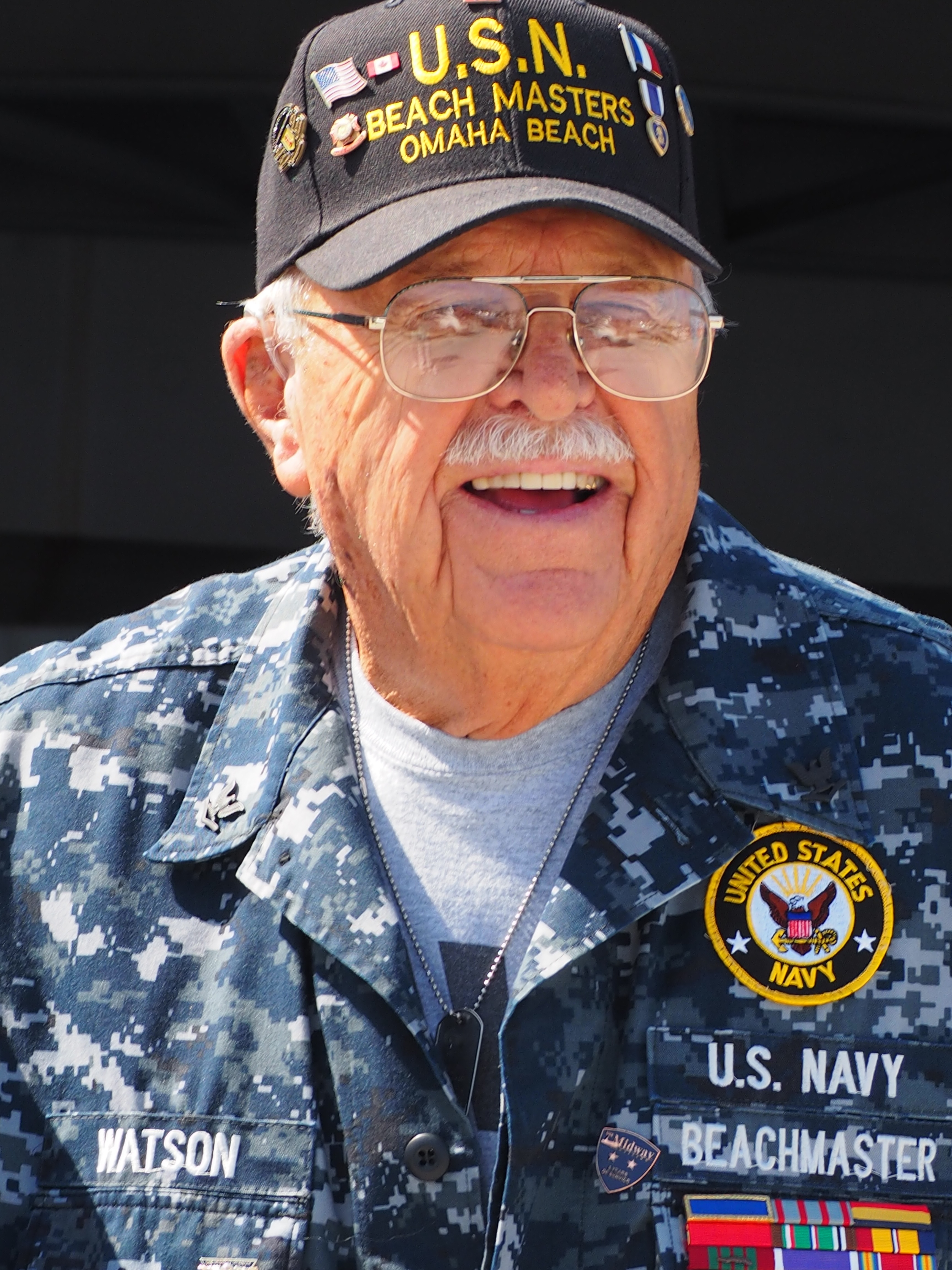
–Photos by C. Coimbra
Bob Watson keeps history alive. The word “beachmaster” sets his place in history. Truthfully, when I met him last Saturday and saw the word embroidered in white threads beneath U.S. Navy on the octogenarian’s blue camos, I had to look the word up.
You see, in my line of volunteerism as a marine wildlife docent that chats up northern elephant seals, the word “beachmaster” has an entirely different connotation.
But for Bob Watson, a World War II veteran who was part of the first wave of the young men that stormed Omaha Beach in Normandy seventy years ago, his job as a beachmaster brings him celebrity today. No! He’s more than a celebrity. How about “…a national treasure,” according to Cmdr. Chris Nelson, BMU-1’s commanding officer?
For the short time I spent with Watson on Saturday, I’d call him a good person who draws crowds like a magnet—and that’s before they hear his incredible story of his willful determination as an 18-year-old on June 6, 1944.
Here’s a quick retelling of what happened on that day:
On the 6th of June in 1944, D-Day, the weather was drizzly, cold and rainy, complicating a horrific scene of chaos. About 1,000 yards from the beach, Bob’s landing craft – an LCM (Landing Craft Mechanized) holding 71 Big Red One (1st Infantry Division) troops and four Navy Beach Battalion crew – hit a Teller mine and exploded. 55 men were killed instantly, body parts flying, and Bob was thrown out…After submerging for some time due to the heavy kit all soldiers and sailors hitting the beach were wearing, his flotation device brought him back to the surface gasping and in shock. Quickly he was picked up by a Zodiac ferrying floaters to the beach.
Responsible for 1/18 of Omaha Beach, which is a little over five miles in length, the 6th Beach Battalion lost 25% of its personnel on the way to or on the beach.
When Bob touched the sand it was about 7:47 a.m. Terror and chaos reigned. Saving Private Ryan’s depiction of the scene could do only faint justice to the true horror American servicemen were experiencing on the beach. Everything was on fire. Landing craft were burning, their ammunition blew up, bodies and parts of bodies littered the beach, and the Germans, who had excellent equipment and training, poured on the machine gun and artillery fire.
As beachmaster, Bob’s job was to “keep the troops, materials, equipment and vehicles moving up the beach.” He forged ahead and helped an Army medic, fired off rounds, and commandeered a bulldozer to clear debris and cut in a road for troops and vehicles. That’s when the bulldozer hit a bouncing Betty anti-personnel mine. Bob survived that explosion too. He stayed on at Omaha Beach for 28 days.
But how did I come to meet this amazing person last Saturday?
If my grandson wasn’t celebrating his 7th birthday in San Diego; if his party wasn’t delayed by an hour; if I wasn’t hopelessly curious and then amazed at the size of the USS Midway Aircraft Carrier on public display as a museum; if I did not park my car in this one lot of many, many parking lots for the museum—just to kill some time; and if USN Beachmaster Bob Watson wasn’t unloading his display that he sets up in the museum as we approached the entrance; and if I probably didn’t reek of a volunteer-type, I never would have had the absolute honor of this older gentleman’s question posed to spouse and me: “You look like nice people. Do you want to get into the museum free?”

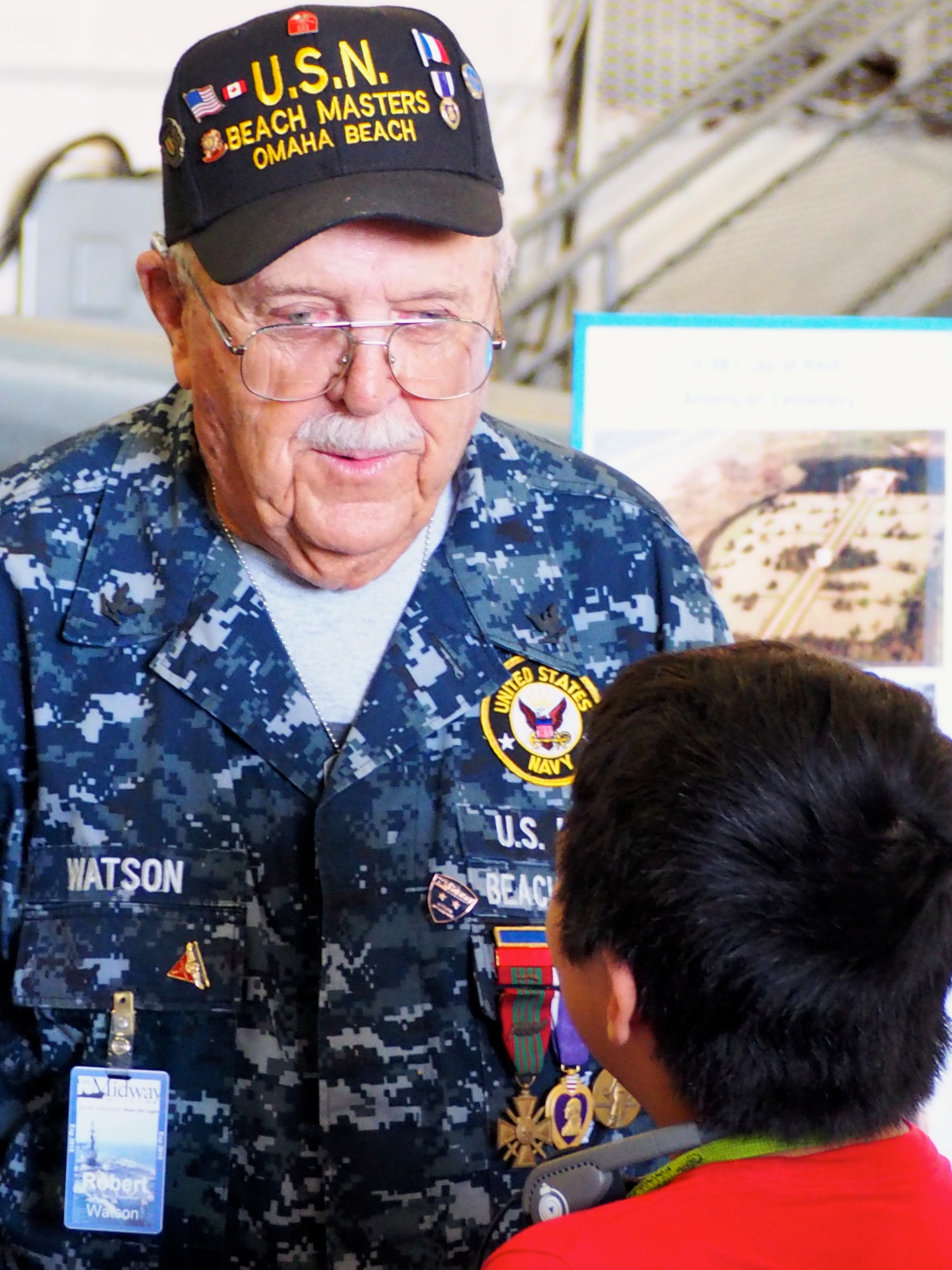
We helped Bob get his gear out of his car while he slid into his blue camo jacket, laden with purple and gold medals. We followed him thru the massive ship’s maze as he told officials, “They’re with me,” and the officials waved the three of us thru.
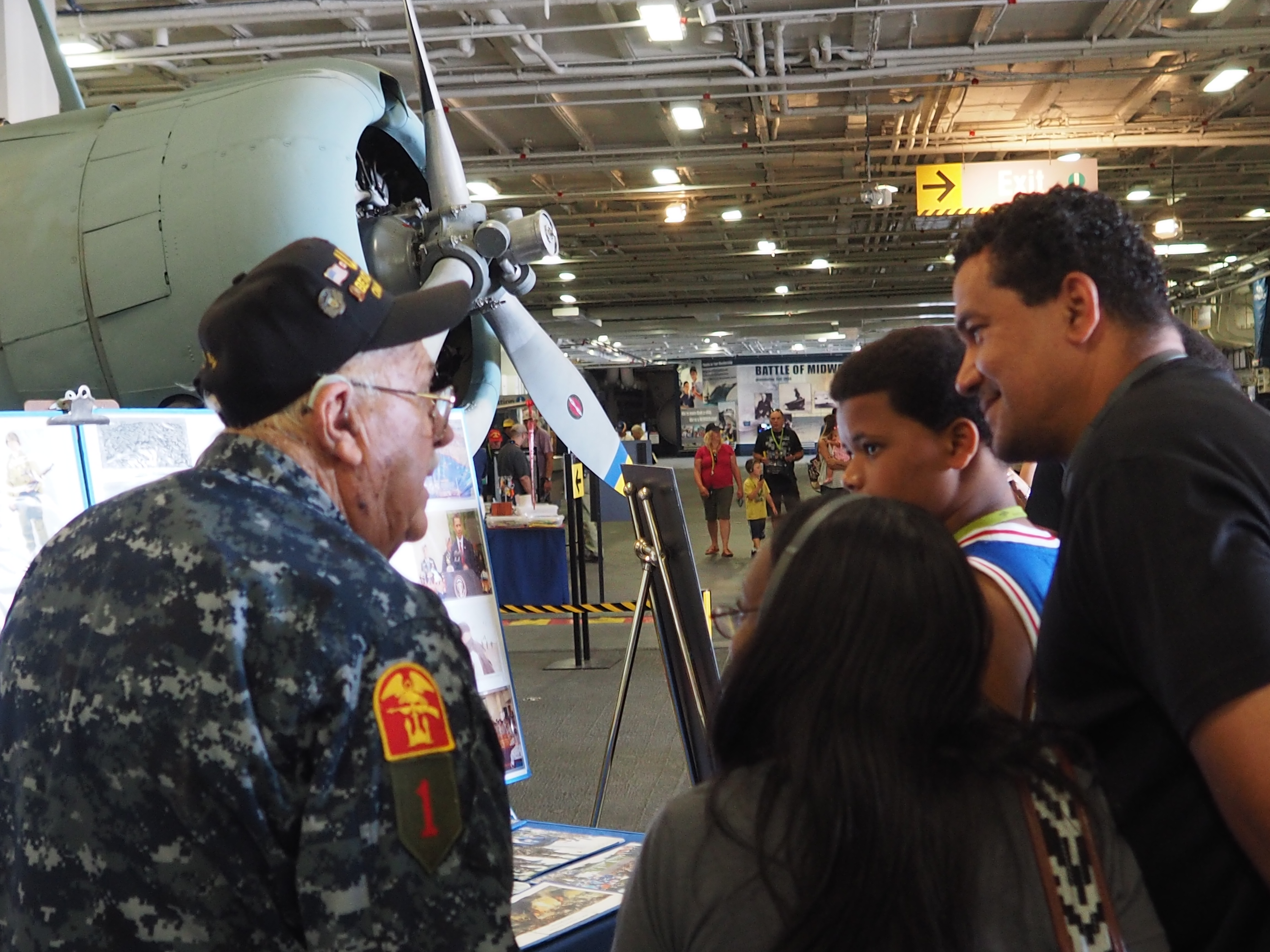
For the next 45 minutes we helped Bob carry and set up an 8-foot table next to a roped-off vintage airplane; I covered the table with a blue cloth that read “ USS Midway Museum,” and Bob said, “You’re definitely a volunteer. How can I tell? You know how to set up a display.” I laughed as we each broke out a sweat in the warm innards of that massive WWII vessel. A crowd began gathering around the display of priceless photos, and news clips. Like a magnet, young and older folks circled Bob, asked questions and listened as he shared his tales of an American youth’s exceptionalism 70 years back.


 The Muse Pallet